

A Public Resource Compiled by the

Prohibited or restricted

Peru keeps its GMO moratorium but opens a narrow path for some gene-edited crops

Peru remains one of the more restrictive countries in Latin America on agricultural biotechnology. Law 29811 imposed a moratorium on the entry and production of living modified organisms for cultivation or breeding, and Law 31111 extended that moratorium through December 31, 2035. The current framework is implemented through Supreme Decree No. 012-2023-MINAM, which keeps the moratorium in place for organisms that fall within Peru’s GMO definition. The moratorium targets cultivation and environmental release, not every form of laboratory research.

What changed in 2026 is not the moratorium itself, but the way Peru decides whether a product is covered by it. In March 2026, the Ministry of the Environment approved new guidelines for determining whether products developed with newer biotechnological tools qualify as living modified organisms under existing law. The ministry later said the guidelines were designed to support scientific research and help determine, on a scientific basis, whether products obtained through techniques such as gene editing should be treated as GMOs.

In practice, that creates a case-by-case filter rather than a blanket exemption. Peru has not lifted its moratorium, and it has not created a separate gene-editing law. Instead, it now has a formal pathway for deciding whether a given product developed with new breeding tools falls inside or outside the existing moratorium. That is a meaningful shift because it opens the door for some transgene-free products to be treated differently from classic transgenic GMOs.

The move is more limited than Peru’s failed 2024 reform effort. In which the agriculture ministry tried to loosen the moratorium for some crops, but the Peruvian congress rejected the proposal. The new 2026 guidelines work within the old system rather than replacing it.

The practical effect is to reduce uncertainty for research and early-stage product development. The Ministry of the Environment has framed the new rules as a way to support scientific work and strengthen Peru’s agrobiodiversity, including crops with better resistance to drought, frost, pests, and other production pressures. 

For food-producing animals, including aquaculture species, Peru remains restrictive in practice. The moratorium still applies to organisms intended for breeding or release into the environment, and reports do not indicate any approved gene-edited animals in commercial production. Research exists, but the country remains in a pre-commercial phase for animal applications.

In sum, Peru is no longer best described as a simple blanket ban on all gene editing. It still prohibits products that are classified as GMOs under the moratorium, but it now has a clearer case-by-case process that could allow some transgene-free products to fall outside that category.

NGO Reaction

Opposition in Peru is still rooted in biodiversity, seed sovereignty, and the protection of small farmers rather than in fine technical distinctions between gene-editing methods. Conveagro has argued that weakening the moratorium would threaten biodiversity and food security, while the broader campaign “Biodiversity is Our Identity” has long framed Peru’s anti-GMO position as part of a wider defense of native crops, rural livelihoods, and national food identity.

There has not yet been a major, coordinated public campaign aimed specifically at the March 2026 guidelines. But the political pattern is familiar: Peru’s anti-GMO coalition has already shown that it can block broader reform, and it is likely to view any pathway that could ease market access for gene-edited products with the same caution. A recent Conveagro statement shows that the coalition remains firmly opposed to reopening the moratorium.
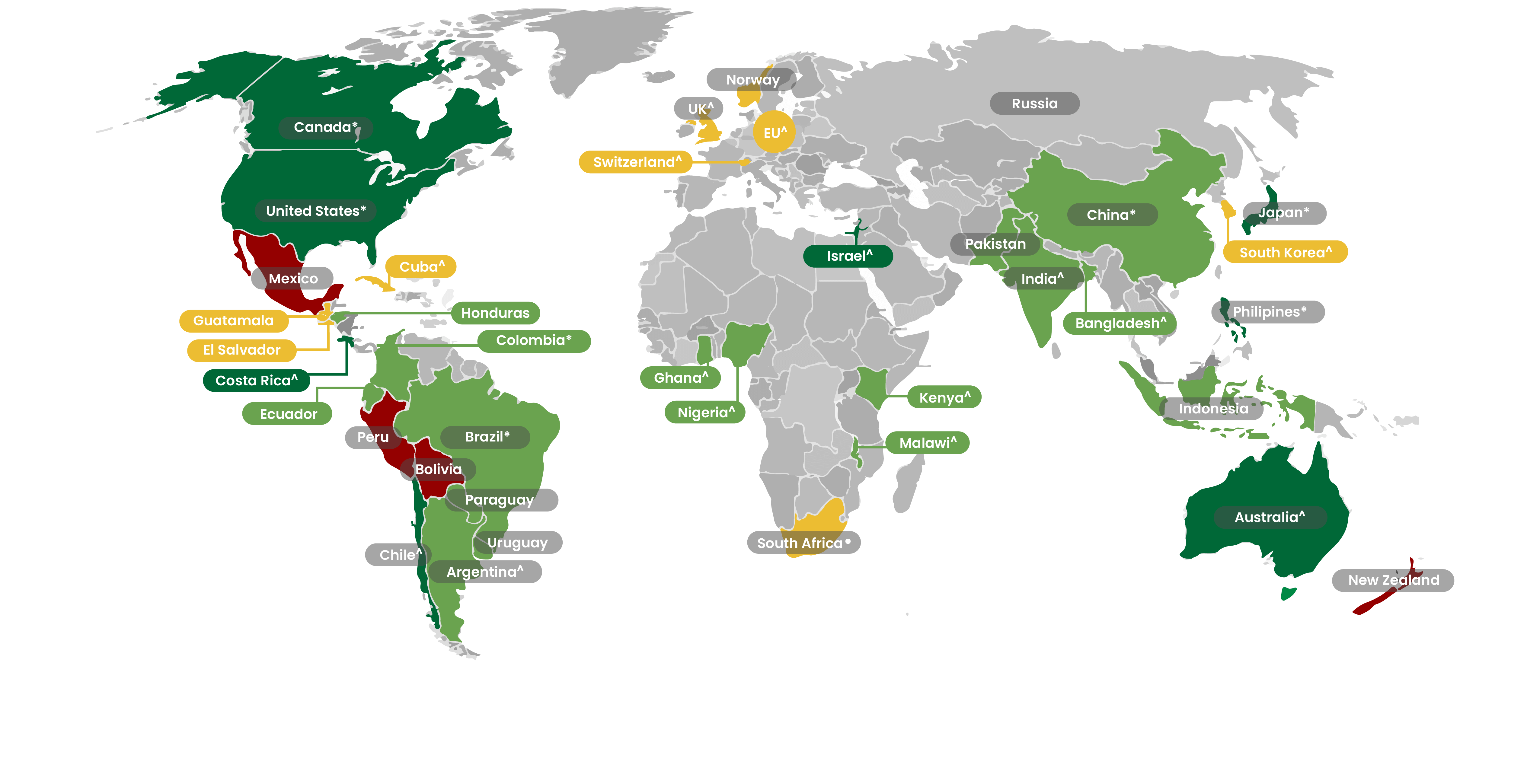
Regulations of gene editing and new breeding techniques (NBTs) worldwide are quickly evolving. Click on a country or region for more information on its regulatory status, what crops are approved or in development, and reactions from regional NGOs. The Gene Editing Index ratings represent their current status and will be updated as new regulations are approved.

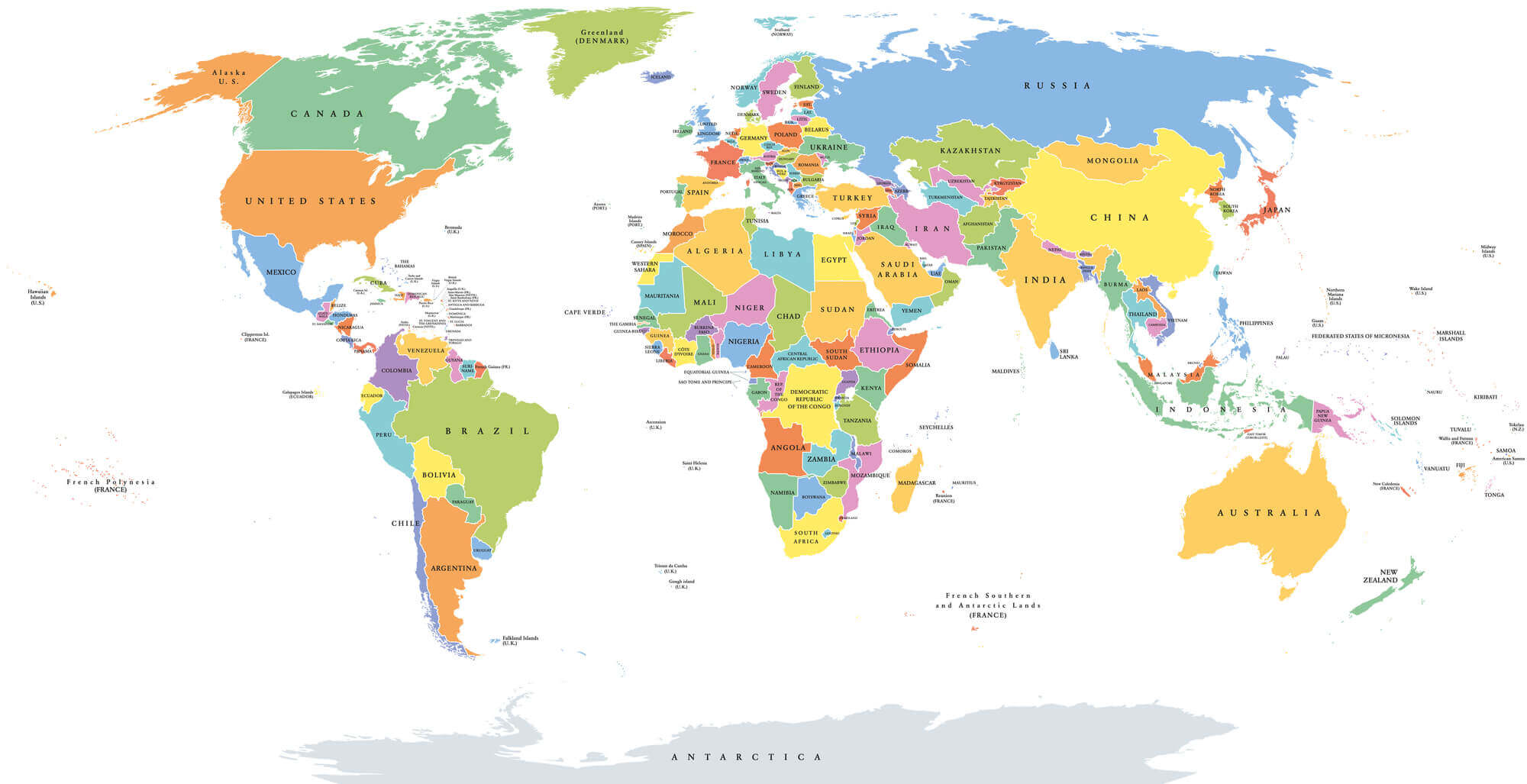
World single states political map

European Union

European Union

Switzerland

Switzerland

Brazil

New Zealand

New Zealand

United States

United States

Australia

Australia

Canada

China

United Kingdom

United Kingdom

Israel

Argentina

Argentina

Japan

Mexico

Russia

Chile

Uruguay

Paraguay

India

Africa

Ukraine

Southeast Asia

Southeast Asia

Central America

Central America

Colombia

Norway

Ecuador

Cuba

Map Countries

European Union

Switzerland

New Zealand

United States

Australia

United Kingdom

Argentina

Southeast Asia

Central America

Argentina

Australia

Central America

European Union

New Zealand

Southeast Asia

United Kingdom

United States

Agriculture Gene Editing Index
Compare Regulatory Restrictions Country-to-Country

Gene editing regulations worldwide are evolving. The Gene Editing Index ratings below represent the current status of gene editing regulations and will be updated as new regulations are passed.

Ratings Guide
 

Regulation StatusRating
Determined: No Unique Regulations*10
Lightly Regulated8
Proposed: No Unique Regulations†6
Ongoing Research, Regulations In Development5
Highly Regulated4
Mostly Prohibited2
Limited Research, No Clear Regulations1
Prohibited0
Lightly Regulated: Some or all types of gene editing are regulated more strictly than conventional agriculture, but not as strictly as transgenic GMOs.
*Determined: No Unique Regulations: Gene-edited crops that do not incorporate DNA from another species are regulated as conventional plants with no additional restrictions.

†Proposed: No Unique Regulations: Decrees under consideration for gene-edited crops that do not incorporate DNA from another species would no require unique regulations beyond current what is imposed on conventional breeding.

Crops/Food:
Gene editing of plants and food products. Research and development has mostly focused on disease resistance, drought resistance, and increasing yield, but more recent advances have produced low trans-fat oils and high-fiber grains.
Animals:
Gene editing of animals, not including animal research for human drugs and therapies. Fewer gene edited animals have been developed than gene edited crops, but scientists have developed hornless and heat-tolerant cattle and fast-growing tilapia may soon be the first gene edited animal to be consumed.

Rating by Country / Region
Click either column header to sort by that column

Swipe right/left if all columns aren't visible

Country / RegionFood / CropsAnimalsAg Rating
Ecuador101010
Norway666
Africa555
Japan888
Brazil101010
Canada888
Russia555
Argentina101010
Israel1057.5
Australia888
Switzerland555
China555
US1047
Chile1015.5
New Zealand444
Ukraine111
Central America666
Paraguay101010
Uruguay666
India666
UK222
Mexico111
EU222
Colombia1015.5
Country / RegionCrops / Food Rating
Australia^4
Canada*4
Chile^4
Costa Rica^4
Israel^4
Japan*4
Philippines*4
United States*4
Argentina^3
Bangladesh^3
Brazil*3
China*3
Colombia*3
Ecuador3
Ghana^3
Honduras3
India^3
Indonesia3
Kenya^3
Malawi^3
Nigeria^3
Pakistan3
Paraguay3
Uruguay3
Cuba^2
Guatamala2
El Salvador2
European Union^2
Norway2
South Africa^2
South Korea^2
Switzerland^2
United Kingdom^2
Bolivia1
Mexico1
New Zealand1
Peru1
Russia0

Approved Gene Edited / NBT Crops
Current list of foods developed by New Breeding Techniques that are approved for sale.

ProductDescriptionCountryCompany
Waxy cornCorn with high starch content developed using CRISPR.Approved:
Japan (2024)
Corteva Agriscience
Non-browning lettuceGreenVenus
Non-browning romaine lettuce.
Approved:
United States (2024)
Intrexon
Slick-coat cattlePRLR-SLICK cattle
Cows developed using CRISPR to grow short hair, which results in improved heat tolerance, which allows them to gain weight more easily.
Approved:
United States (2024)
Acceligen
Fungal resistant wheatEdit approved that confer resistance to a common fungal infection called powdery mildew that can be applied to different varieties.Approved:
China (2024)
Suzhou, Chinese Academy of Sciences
Mustard greensConscious Greens
Milder, less bitter mustard green developed using CRISPR-Cas12a.
Approved, available:
United States (2023)
Pairwise
Non-browning bananaBanana developed using CRISPR to slow the browning process for prolonged shelf-life.Approved:
Philippines (2023)
Tropic Biosciences
SeabreamRed Seabream
Fish developed using CRISPR disabling a gene suppressing muscle growth, allowing the fish to grow larger.
Approved, available:
Japan (2021)
Regional Fish Institute
GABA tomatoSicilian Rouge
Tomato edited using CRISPR to contain more GABA, a compound in tomato fruits and known to lower blood pressure.
Approved, available:
Japan (2021)
Sanantech Seed
Fast growing pufferfishTiger Pufferfish
Fish developed using CRISPR disrupting a gene controlling appetite, allowing the fish to eat more and grow faster.
Approved, available:
Japan (2021)
Regional Fish Institute
High-oleic soybean oilCalyno
Soybean oil with fewer saturated fats and zero trans fats, developed using a gene-editing technique called TALENs.
Approved, available: 
United States (2019)
Calyxt
Non-browning mushroomWhite Button Mushroom
Non-browning mushroom developed using a gene-editing technique called TALENs.
Approved:
United States (2016)
Pennsylvania State University
Non-browning appleArctic Apple
Non-browning apple (multiple varieties) developed with RNA interference, a more traditional New Breeding Technique (NBT). Varieties include Golden, Granny, Fuji, Gala, Honey.
Approved, available:
Canada (2017)
Approved, available:
United States (2015)
Okanagan Specialty Fruits
Non-browning potatoWhite Russet Potato
Non-browning, blight protection, lowered sugars, and low acrylamide potato developed with RNA interference.
Approved, available:
United States (2015)
Available:
Canada (2015)
Simplot
Rapeseed/CanolaDeveloped to be herbicide-tolerant canola using oligonnucleotide-direct mutagenesis (ODM).Approved:
United States (2014)
Canada (2013)
Cibus

Global gene editing regulatory landscape

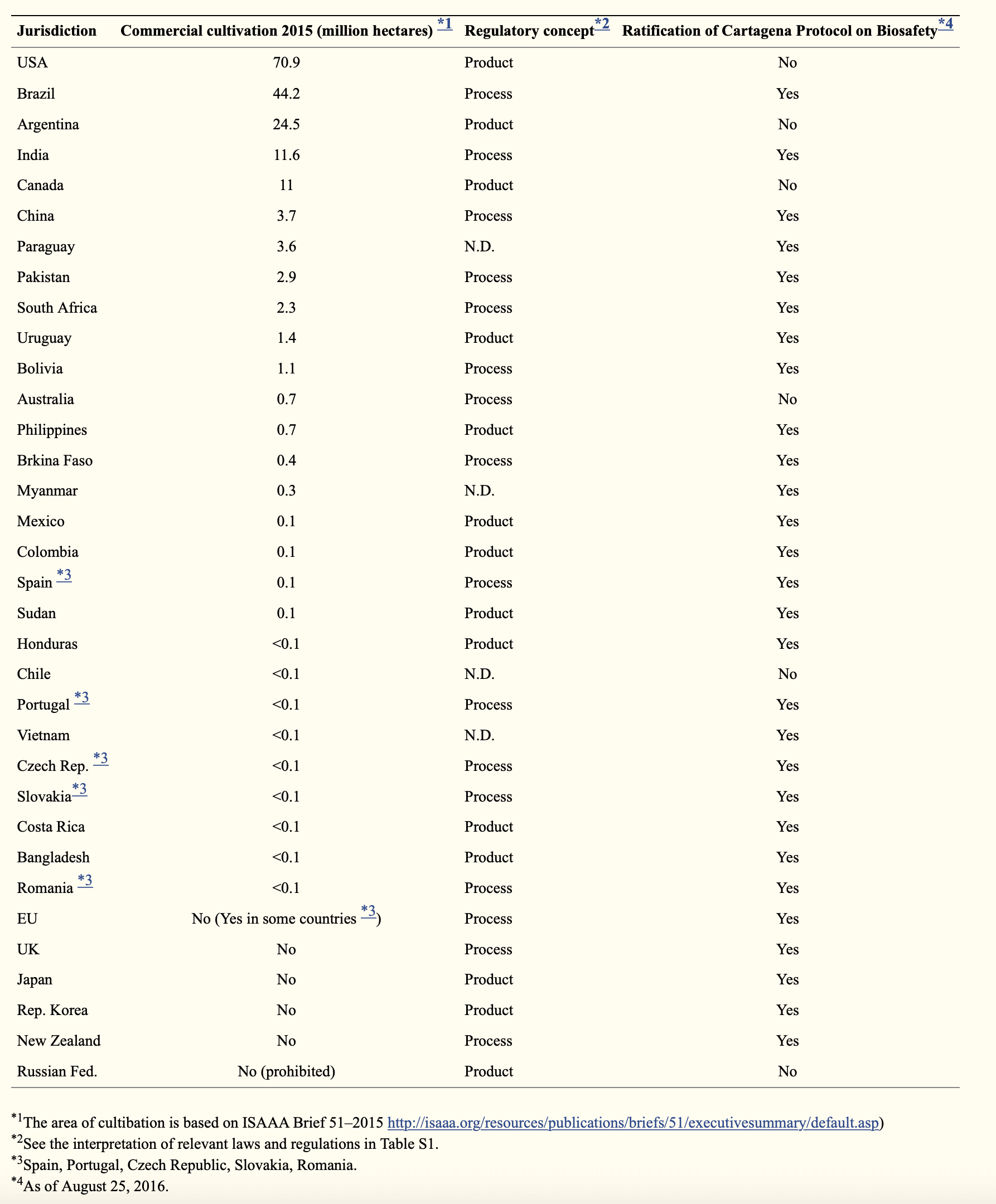
The regulations on genetically engineered crops and animals are emerging out of the regulatory landscape developed for transgenic GMOs. Regulations across 34 countries where transgenic or gene edited crops and animals are commercially allowed (as of 12/19) are guided in part by two factors:
 
 
Whether the country has ratified the international agreement that took effect in 2003 that aims to ensure the safe handling, transport and use of living modified organisms (LMOs) resulting from biotechnology that may impact biological diversity, also taking into account potential risks to human health. It entered into force for those nations that signed it in 2003. It applies the ‘precautionary approach as contained in the Rio Declaration on Environment and Development. The US, Canada, Australia and Chile and the Russian Federation have not signed the treaty.
 
 
Whether regulations are based on the genetic process used to create the trait (conventional, mutagenesis, transgenesis, gene editing, etc.) or the final product.Transgenic crops and animals (aka GMOs) are product regulated in many countries including the US and Canada, while the EU, India, China and others regulate based on how the product is made. There is almost an equal number of countries with product- and process-based regulations. It’s not clear how much this distinction matters. It’s somewhat true that countries with product-based regulation have more crops approved and the approval process is more streamlined, but there are contradictions. For example, Brazil and Argentina have emerged as GMO super powers using different regulatory concepts, while there is no GMO commercial cultivation in Japan, North Korea, and the Russian Federation, which employ product-based regulations. How this will effect gene editing regulations is also unclear. For example, Japan, which has no commercialized GMOs, is emerging as a leader in the introduction of gene edited crops.
Agricultural Landscape

Gene editing is a set of techniques that can be used to precisely modify the DNA of almost any organism. It is being used for applications in human health, gene drives and agriculture. There are numerous gene-editing tools besides CRISPR-Cas 9, which gets most of the attention because it is a comparatively easy tool to use.

Gene editing does not usually involve transgenics – moving ‘foreign’ genes between species. It also refers to a specific technique in contrast to the general term GMO, which is scientifically ambiguous, as genetic modification is a process not a product. Most gene editing involves creating new products by deleting very small segments of DNA (sometimes in agriculture called Site-Directed Nuclease 1 or SDN-1 techniques), which can silence a gene or change a gene’s activity. Countries are evaluating whether or not to regulate this type of gene editing, since it is so similar to natural mutations. The GLP’s Gene Editing Index ratings reflect the regulatory status of SDN-1 techniques, which are the most liberally regulated and will generate most products in the near term.

To develop different products, gene editing can change larger segments of DNA or add DNA from other species (a form of transgenics sometimes in agriculture called SDN-2 or SDN-3 techniques). While many countries are not regulating or lightly regulating SDN-1 techniques, most are moving toward tightly regulating or even restricting SDN-2 and SDN-3.

For more background on the various gene editing SDN techniques, read background articles here and here.

Share via